
People
Research in the Reinard group
The Reinard group is active in the production of antibodies in diatoms. We have developed a complete workflow that allows us to produce antibodies of various formats (such as IgG, scFv-Fc, Fab2) at very high yields. We focus on the production of antibodies which can be used in the field of diagnostics (IVD), well known examples for such applications are Covid-19 tests or pregnancy tests. The antibodies used in these tests are currently being produced (almost) exclusively in animals. Half a million mammals are being used annually in the EU just for antibody production, which is why the EU Reference Laboratory for Alternatives to Animal Testing of the EU Commission [EURL-ECVAM] has recommended to completely abandon the use of animals for antibody production.
Our spin-off company Phaeosynt is your contact if you are a company interested in our antibodies. You can find further informations on the facultys website.
The Laborjournal presented our work in January 2025. The article is available online here German).
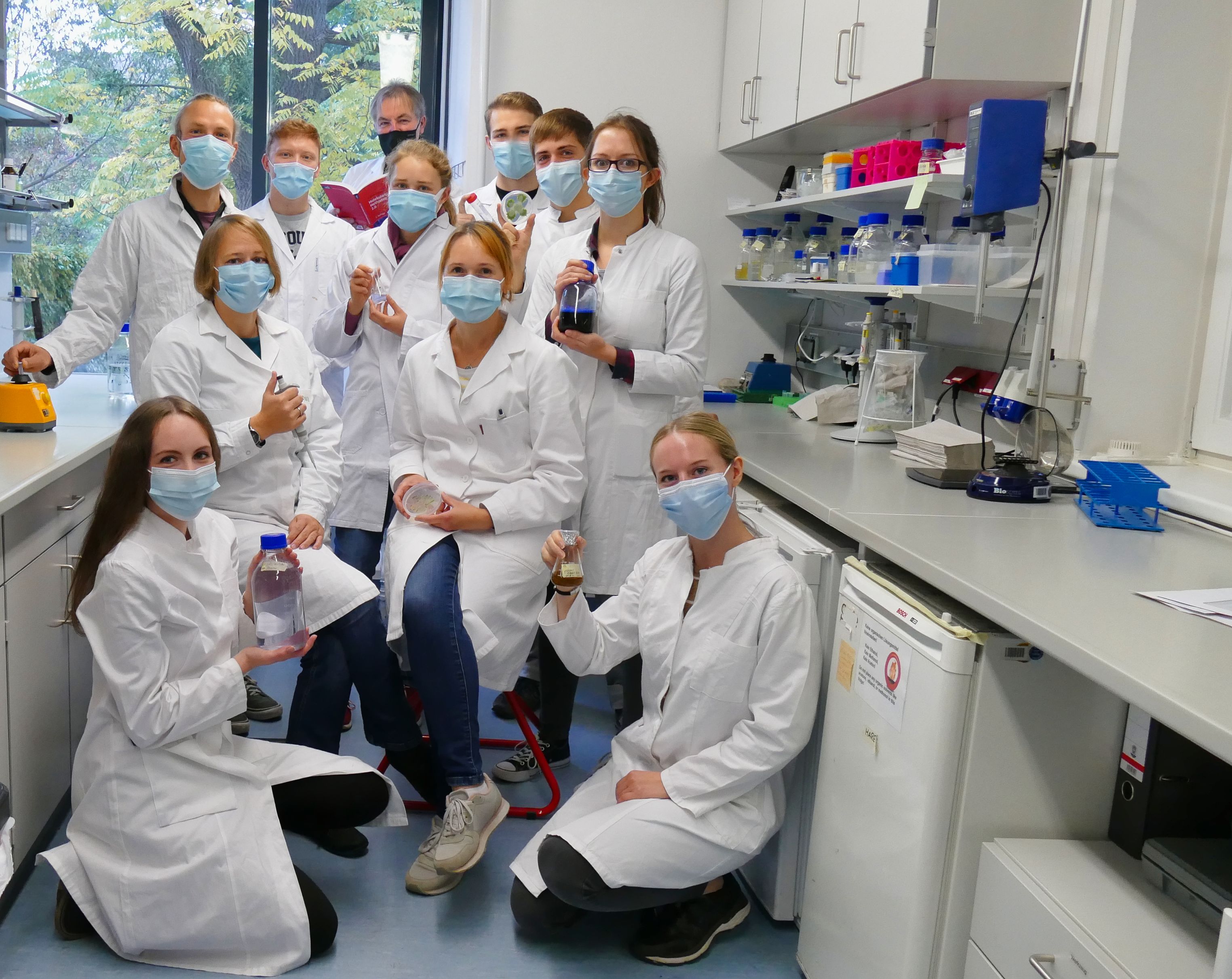
Besides PhD students Ilka Kerren and Stas Hans and the technical assistant Eva Plönnigs, master and bachelor students from different study programs are joining our team. In addition, we welcome guest students from Northeastern University Boston, who greatly enrich our laboratory life.
Phaeosynt GmbH's first product will be the world's first vegan and sustainable pregnancy test, with a market launch planned for summer 2025. Phaeosynt has already won several start-up awards, including the top prize in the university start-up category of the Startup-Impuls competition, one of the most highly endowed regional start-up competitions in Germany.
Together with Phaeosynt, we are working on the production of secondary antibodies for use in procedures such as ELISA or immunostaining as part of the BMBF AniSAn project. The image on the right shows an immunofluorescence with one of our secondary nanobodies developed as part of this project.


In 2017, we successfully completed the first genome project of the duckweed Wolffia australiana. However, our hopes for an efficient and stable production system for our antibodies were not fulfilled.
The story is much better with the diatom Phaeodactylum tricornutum, which has proven to be the ideal production system for us. At least after we have performed many optimization steps. Today, we produce our pharmaceutically relevant proteins exclusively in P. tricornutum.
With this diatom, we achieve antibody production levels which are in a comparable range with established animal systems such as CHO cells (oviduct cells of the Chinese hamster). Our system is now widely established, and we are currently transferring our know-how to our spin-off company Phaeosynt.
Our sustainable antibody production process already meets the recommendation of the EU Commission's Reference Laboratory for Alternatives to Animal Testing (EURL ECVAM). Still there are nearly 1/2 million (per annum) animals, which are still used for the antibody production within the EU (data from 2017, COM/2020/16). In addition to the animal welfare aspect, our production system has many other advantages such as sustainability, good scalability and easy purification of the heterologously produced proteins.


For cloning, we prefer the Golden Gate-based MoClo system, which we have partially adapted to our needs, but Gibson Assembly or PCR-based methods are also used.
Depending on the species, plants are transformed using Agrobacteria-mediated transformation, the gene gun or via protoplasts. Since we have the complete genome data of our plants, genome editing procedures using CRISPR/Cas9 are also used. For the purification of the recombinant proteins, magnetic beads (Frenzel et al. 2003), various column chromatographies, e.g. using Äkta Prime, as well as ultrafiltration procedures via Äkta Flux S are applied. Detection is performed by immunobiochemistry using classical immunostaining or ELISA, immunofluorescence microscopy, or surface plasmon resonance.


We are in charge in various research collaborations. You can find out more about the most important on the following pages:
- AniSAn: Production of animal-free secondary antibodies (BMBF grant). Cooperation with Phaeosynt
- LACoP: Production of low allergy food plants such as peanuts or mustard (BMBF grant, ended 2021).
- Sweet itch: production of therapeutic antibodies for the treatment of sweet itch in horses (financed by industry).
We run many projects in close cooperation with the Institute of Biochemistry, Biotechnology and Bioinformatics of the TU Braunschweig. Prof. Hust's research group produces recombinant antibodies in various formats.
Furthermore - also due to an exchange programme with the Northeastern University Boston, which has been supported by the DAAD since the 70s - we maintain close cooperations with working groups at the university there, e.g. with the group of Carolyn Lee-Parson (https://lee-parsons.sites.northeastern.edu).
Since our field of activity is very application-oriented, we also have many contacts to industrial companies of different sizes.